
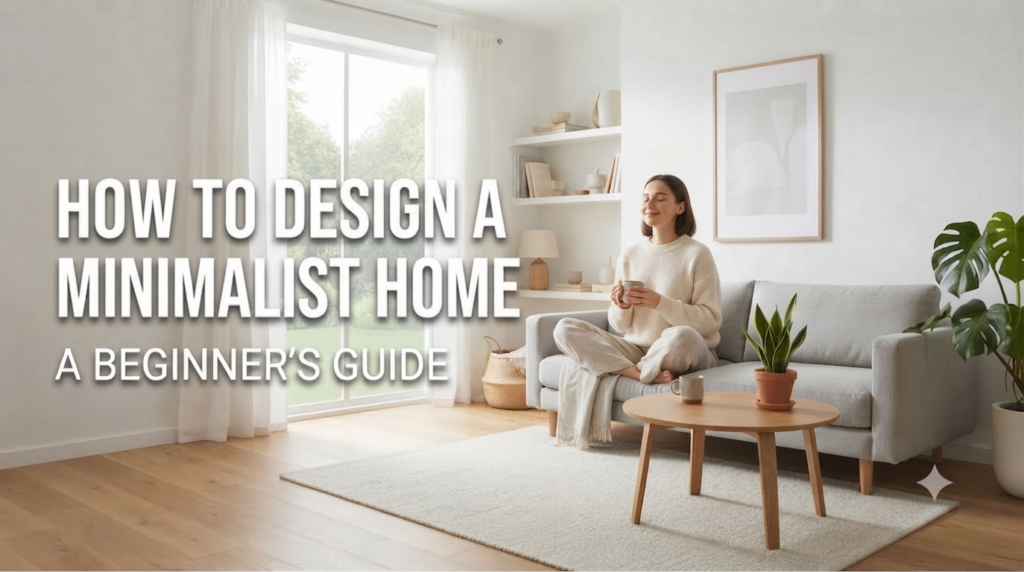
HOW TO DESIGN A MINIMALIST HOME: A BEGINNER’S GUIDE
DESIGN A MINIMALIST HOME WITH US Introduction Minimalism isn’t about living with nothing — it’s about living with intention. Whether you’re a design student learning the fundamentals or a homeowner looking to create a peaceful sanctuary, minimalist design offers a timeless approach that combines beauty with functionality. In this guide, we break down the core principles of minimalist home design in a way that’s easy to understand and even easier to implement. What Is Minimalist Design? Minimalist design is a style that emphasizes simplicity, clean lines, and a “less is more” philosophy. It emerged from the modernist movement and Japanese design principles, focusing on: •Intentional spaces with only essential elements •Neutral color palettes that create calm •Functional furniture that serves a clear purpose •Negative space that allows the eye to rest The Core Principles of Minimalist Design 1. Quality Over Quantity Instead of filling your home with many items, invest in fewer, higher-quality pieces. One well-crafted sofa beats three cheap ones every time. Student Tip: This principle applies to design projects too. In presentations, show one strong concept executed well rather than multiple half-baked ideas. 2. Functional Simplicity Every item in a minimalist home should serve a purpose. Ask: “Does this add value to my daily life?” If not, reconsider keeping it. 3. Clean Lines and Simple Forms Minimalist furniture typically features: •Straight edges or gentle curves •Geometric shapes •Minimal ornamentation •Exposed legs, for visual lightness 4. Neutral Color Palette The foundation of minimalist design uses: •Whites, creams, and off-whites •Grays in various tones •Beiges and taupes •Black for contrast and grounding Add warmth with natural materials like wood, stone, or linen — or a single considered accent, such as terracotta, brass, or an indigo-dyed textile. 5. Decluttered Spaces Clutter is the enemy of minimalism. This means: •Clear surfaces — countertops, tables, shelves •Hidden storage solutions •Regular editing of possessions •Thoughtful display of select items Step-by-Step: Creating Your Minimalist Home Step 1: Declutter First, Design Second Before buying anything new, remove what doesn’t serve you: 1.Go room by room 2.Sort items into: Keep, Donate, Discard 3.Keep only what you use regularly or truly love 4.Find storage solutions for essentials 5.Reassess in a week — clarity often takes a second pass Step 2: Choose a Foundation Palette Settle on two to three base tones before adding anything else: •One dominant neutral for walls and large surfaces •One secondary tone for furniture and textiles •One considered object — not decoration for its own sake, but something with meaning Step 3: Invest in Fewer, Better Pieces Build the room around a small number of anchor pieces rather than filling every corner: •One seating piece that earns its place •One storage piece that hides the rest •One considered object — not decoration for its own sake, but something with meaning Step 4: Let Light and Space Do the Work Minimalism relies on what isn’t there as much as what is: •Keep window lines unobstructed •Favor low-profile furniture that doesn’t crowd the eye •Leave visible floor and wall space between pieces Step 5: Edit, Don’t Just Decorate Once the space is set, resist the urge to keep adding: •Live with a room for a few weeks before introducing anything new •Remove one item for every new one brought in •Revisit the space seasonally, not constantly Bringing It All Together Minimalism is not a fixed formula. It is a discipline of asking what a space truly needs, then having the restraint to stop there. The palette may lean neutral, but warmth still has a place — a single terracotta vessel, a brass fixture, an indigo-dyed throw can carry more presence in an edited room than a dozen decorative objects ever could. A minimalist home is never finished in a weekend. It is a practice you return to — editing, reconsidering, letting a space breathe a little more each time. What does “enough” look like in your own home? Ready to design a space that feels this considered? Get in touch with Midoree Studio to begin.